High Performance Home vs Standard Home: What’s the Difference?
building performance NZ, standard home vs energy efficient home,
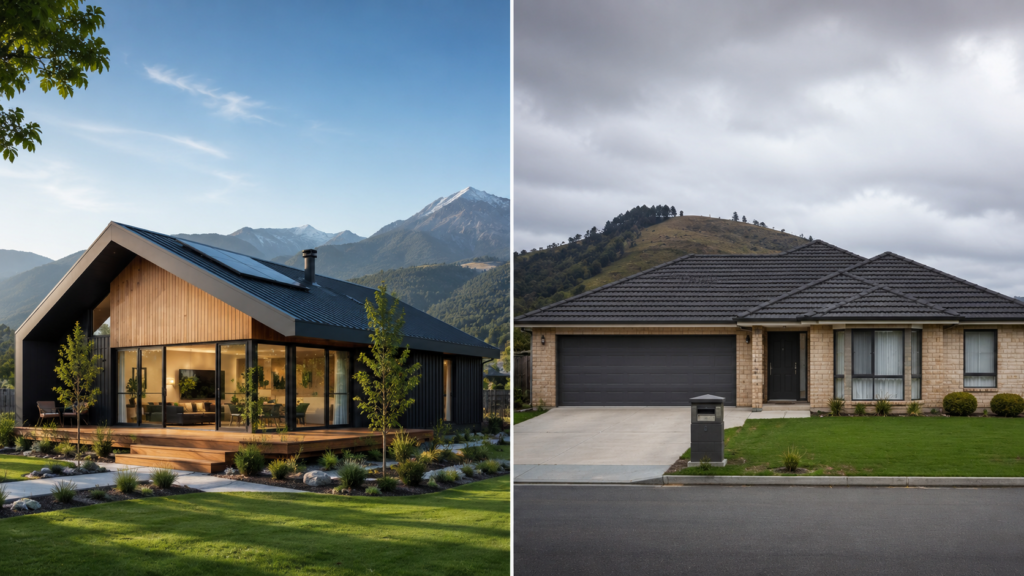
On paper, a standard new home and a High Performance Home can look almost identical: similar floor plan, similar cladding, similar roofline. The difference isn’t visible from the street. It shows up in how the house behaves once someone is actually living inside it: how quickly a room warms up on a frosty morning, how much the temperature swings between day and night, and what the power bill looks like in the depths of a Taupō winter.
Where the two builds genuinely diverge
A standard home is generally built to satisfy the New Zealand Building Code, a legal minimum for insulation, weathertightness and structural performance. A High Performance Home starts from the same regulatory baseline and then treats it as the starting point rather than the target, layering in continuous insulation, a measured airtight envelope, high-performance joinery and mechanical ventilation with heat recovery.
The practical differences follow from there. A standard home typically has basic insulation installed to Code minimums, with common gaps at junctions between walls, floors and roofs. A High Performance Home treats the entire envelope as one continuous thermal layer, detailed specifically to eliminate those weak points. A standard home relies on natural ventilation, such as gaps, extractor fans and opened windows, while a High Performance Home uses balanced mechanical ventilation to supply filtered fresh air continuously, without losing the heat already inside.
The build process itself looks different, too
The differences between the two aren’t only visible in the finished home; they show up during construction as well. A standard build generally follows a fairly conventional sequence, with insulation and building wrap installed as separate trades doing their own scope of work. A High Performance Home requires much closer coordination between trades, because airtightness and continuous insulation depend on the plumber, electrician and insulation installer all working around each other’s penetrations carefully, rather than each simply completing their own job independently. This is often the difference that’s hardest to see from a finished spec sheet, but it’s frequently the difference that most affects the final result.
Temperature stability, not just temperature
One of the most noticeable differences has less to do with how warm a home gets and more to do with how stable that warmth stays. In a standard home, indoor temperature often tracks closely with outdoor conditions and whatever heating is currently running: warm near the fire, cooler in the back bedrooms, a noticeable dip overnight once the heating switches off. A High Performance Home’s continuous insulation and airtight envelope significantly reduce that swing, so rooms stay within a much narrower temperature band through the day and night, without constant intervention from a heater or heat pump.
Air quality and moisture management
Standard homes depend on uncontrolled air leakage and the occasional opened window for fresh air, which also means moisture, dust and outdoor pollutants move in and out somewhat unpredictably. This is part of why condensation on windows and in roof spaces is such a common complaint in conventional New Zealand homes over winter. A High Performance Home’s mechanical heat recovery ventilation system continuously exchanges stale indoor air for filtered fresh air, actively managing humidity and reducing the conditions that lead to condensation and mould in the first place.
The cost comparison, honestly stated
A High Performance Home does typically cost more to build than a standard equivalent, since better insulation specification, airtight detailing, upgraded joinery and a ventilation system all add to the build cost. What’s less often discussed is what that money is actually buying: lower heating demand across the life of the home, reduced risk of moisture damage and the maintenance that follows it, and a level of comfort that a standard home generally can’t retrofit its way into without a significant renovation later on.
Noise, not just temperature
Acoustic comfort is one of the more underrated differences between the two. Standard construction, with its gaps and lighter-weight glazing, transmits a surprising amount of outside noise: traffic, wind, neighbouring properties. The same airtight envelope and high-performance joinery that stop heat escaping also happen to be very effective at keeping outside noise out, which is part of why owners of high-performance homes often describe the interior as noticeably quiet, even on a windy day near the lake.
Which one is right for your project
A standard home remains a reasonable option for owners prioritising the lowest possible upfront build cost and planning a shorter-term ownership horizon. A High Performance Home tends to make more sense for anyone planning to stay long term, anyone building in a colder or more exposed location such as the higher elevations around Taupō, and anyone who has already lived through a cold, draughty New Zealand winter and doesn’t want to repeat the experience in a brand-new house.
The clearest way to compare the two isn’t a spec sheet; it’s a conversation about how you actually want the finished home to feel, five, ten and twenty years after the final coat of paint goes on.
Questions, answered.
Everything you need to know before starting a High Performance Home from build timelines to site suitability. Can't find your answer here?
GET IN TOUCHThe main differences are continuous insulation across the entire building envelope, airtight construction that’s tested rather than assumed, high-performance joinery, and mechanical ventilation with heat recovery. Combined, these create a home with far more stable indoor temperatures and healthier air than a standard Code-built house.