What Is a High Performance Home? The Five Principles That Work Together
energy efficient homes, healthy homes, high performance builder Taupo, High Performance Homes NZ,
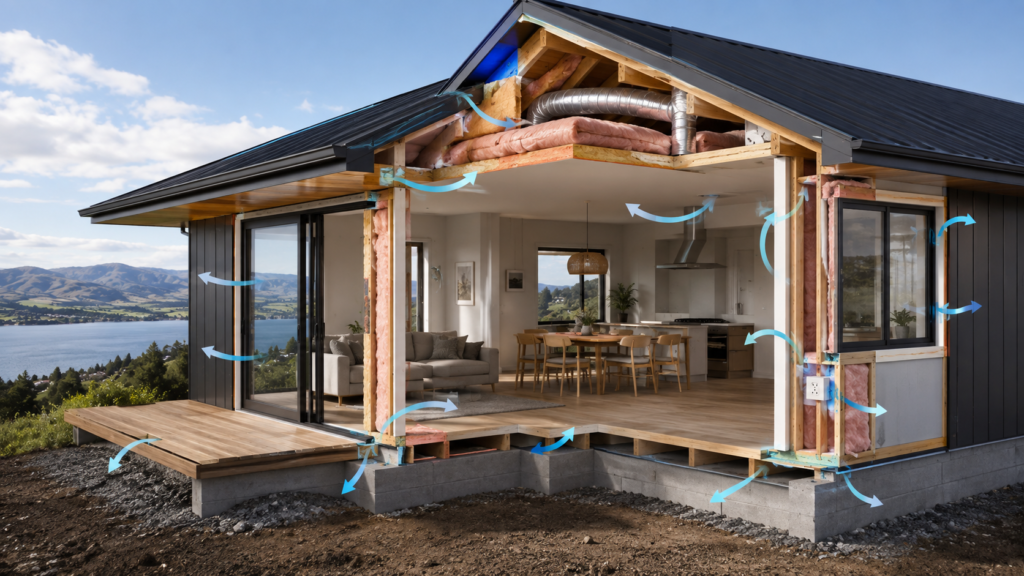
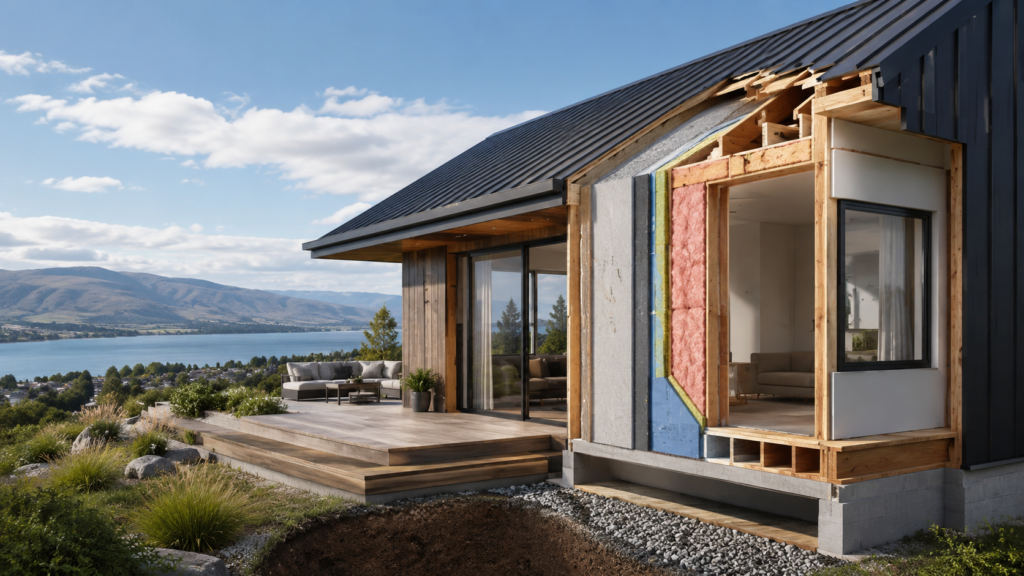
A High Performance Home is a house designed and built as one connected system rather than a collection of separate products. It is not a single feature you can buy, and it is not a certification you either have or don’t. It is the result of five principles working together (considered design, high insulation, an airtight enclosure, high-performance joinery and mechanical ventilation), each one detailed and tested so the finished building performs, visibly and measurably, for the people living inside it.
It helps to think of a standard new-build as a house that meets the rules, and a High Performance Home as a house that was designed around a question the rules never ask: how is this actually going to feel to live in, in ten, twenty, thirty years’ time?
Principle one: considered design
Performance starts long before the first truck arrives on site. Orientation, solar gain and shading are resolved at the design stage so the home works with its section instead of against it: living spaces angled to capture winter sun, eaves sized to shade the same glazing in summer, and window placement chosen for both light and thermal comfort. Skip this step and no amount of insulation added later will fully make up for a house that fights its own site.
Principle two: high insulation, applied continuously
Insulation is the principle most people already know about, but the detail that matters is continuity. It starts at the foundation with an insulated MAXRaft® slab, then continues through the walls and roof without gaps, cold bridges or compressed batts squeezed around framing. A wall with excellent insulation batts but a poorly detailed junction at the floor or roofline will still lose a disproportionate amount of heat through that one weak point, which is why insulation on its own, without the other four principles, rarely delivers the comfort homeowners expect.
Principle three: an airtight enclosure
Airtightness is often confused with a house that can’t breathe. In practice, it means controlling exactly where air enters and leaves the building, rather than leaving it to chance through gaps around skirting boards, dropped ceilings and wiring penetrations. A measured Pro Clima airtight envelope means the insulation can actually do the job it was installed to do, instead of being undermined by draughts moving straight through the wall cavity. This is also the principle that gets tested rather than assumed: a blower door test measures air changes per hour, so the result is a number, not a guess.
Principle four: high-performance joinery
Windows and doors are traditionally the weakest link in a home’s thermal envelope, the place where heat escapes fastest and draughts are most noticeable. High-performance joinery flips that. Thermally broken uPVC frames, argon-filled double or triple glazing, multi-point locking and gasketed seals turn what used to be the weak point into one of the strongest parts of the building envelope, while still delivering the natural light and outlook a home needs.
Principle five: mechanical ventilation with heat recovery
This is the principle that makes the other four liveable. An airtight home needs a reliable way to bring in fresh air, because it will no longer happen by accident through gaps in the building. A heat recovery ventilation system continuously removes stale indoor air and replaces it with filtered fresh air from outside, while recovering much of the heat from the outgoing air to help maintain a comfortable indoor environment. The result is a constant supply of clean, filtered air without the heat loss of simply opening a window.
Why all five have to work together
None of these principles is optional if the goal is genuine performance. Considered design without insulation still loses heat. Insulation without airtightness leaks it straight back out. Airtightness without ventilation traps moisture and pollutants indoors. High-performance joinery without the rest of the envelope is an expensive upgrade wasted on a leaky house. It is the combination, applied consistently through design, detailing and construction, that produces a home that stays warm in winter, cool in summer, quiet, and noticeably easier to breathe in than a standard build.
Why buying ‘eco products’ isn’t the same thing
It’s tempting to think high performance can be achieved by choosing a few premium products: a better heat pump, thicker insulation batts, double glazing instead of single. Those choices help, but they’re not the same as a High Performance Home. A triple-glazed window installed into a poorly sealed frame still leaks air around its edges. Thick insulation batts still lose most of their value if they’re compressed around wiring or interrupted at a junction. The five principles matter because they describe how components are integrated, not which components are used. A builder who understands this will talk about junctions, sequencing and testing as much as they talk about products.
How the principles adapt to New Zealand’s different climates
The five principles don’t change from region to region, but how they’re specified does. A home built at 600 metres elevation near Taupō, exposed to alpine-style winters, generally needs a higher level of insulation and may benefit from triple glazing in key rooms, while a lakeside build at Kinloch or Jetty might prioritise different glazing orientations to manage both winter sun and summer glare off the water. This is why a genuinely high-performance builder assesses each site individually rather than applying one fixed specification to every project: the principles stay constant, but the detailing responds to the site.
If you’re comparing options for a new build or renovation in Taupō and the surrounding Central Plateau, understanding these five principles, and asking how a builder applies each one to your specific site, is the clearest way to judge whether their idea of ‘high performance’ matches yours.
Questions, answered.
Everything you need to know before starting a High Performance Home from build timelines to site suitability. Can't find your answer here?
GET IN TOUCHConsidered design, high levels of continuous insulation, an airtight enclosure, high-performance joinery, and mechanical ventilation with heat recovery. Each principle supports the others, so leaving one out significantly reduces how well the remaining four can perform.