Tag: balanced ventilation
Mechanical Ventilation in High Performance Homes: Why Fresh Air Matters
balanced ventilation, fresh air airtight home, MHRV system NZ,

There’s a question every homeowner should ask before agreeing to an airtight build, and surprisingly few people do: if the house is sealed this well, where does the air come from? It’s a fair question, and the honest answer is that an airtight home without a proper ventilation strategy is not actually a good outcome. The airtightness and the ventilation have to be designed together, as one system, or the result is a sealed box that traps moisture and stale air rather than a healthy home.
The Old Way: Leaky Houses, Accidental Ventilation
Older and standard New Zealand homes get their fresh air mostly by accident, through gaps around windows, doors, floorboards and wall junctions that were never intended as ventilation but function as one anyway. It works, in the sense that air does move through the house, but it’s completely uncontrolled. On a windy day the house loses heat rapidly through those same gaps. On a still day, ventilation drops away almost entirely, and moisture from cooking, showering and simply breathing has nowhere to go.
This is part of why so many older Kiwi homes struggle with condensation on windows, mould in bathrooms and wardrobes, and that particular damp, cold smell that never quite lifts. The house is ventilating badly and losing heat badly at the same time, which is the worst combination available.
Sealing the Gaps Changes the Equation
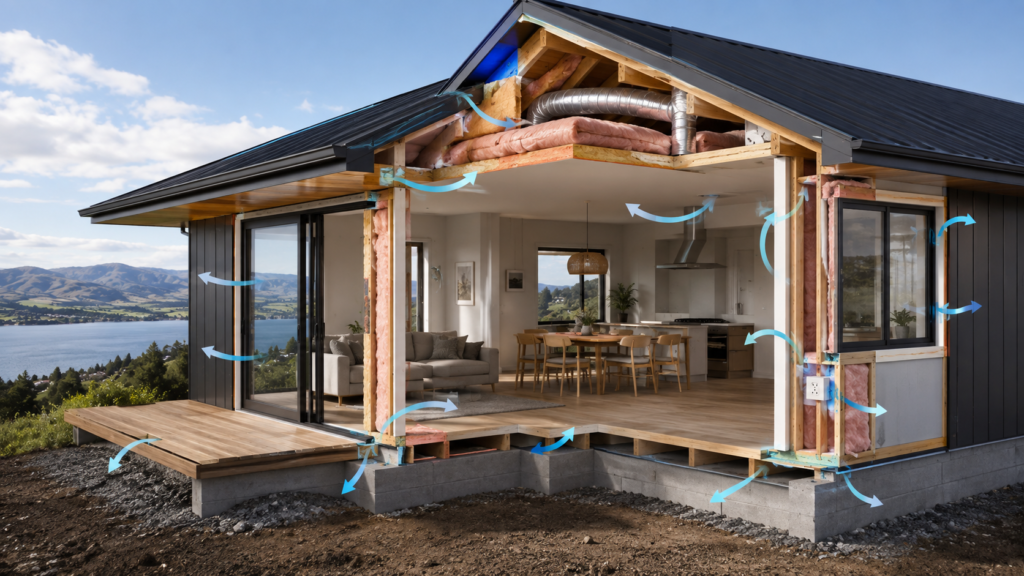
A high performance home closes those accidental gaps deliberately, using an airtight membrane system to stop uncontrolled air movement through the building envelope. This is a genuinely good thing for energy efficiency, because it removes one of the largest sources of heat loss in a typical home. But it also removes the accidental ventilation those gaps were providing, which means fresh air now has to come from somewhere intentional, not somewhere accidental.
Mechanical Ventilation With Heat Recovery, Explained Simply
This is where mechanical heat recovery ventilation, or MHRV, comes in. An MHRV system continuously extracts stale, moist air from wet areas like bathrooms and kitchens, and supplies fresh, filtered air to living spaces and bedrooms. Before the outgoing air leaves the building, it passes through a heat exchanger that transfers most of its warmth into the incoming fresh air. HP Homes installs Stiebel Eltron systems that recover between 70 and 90 percent of that heat, meaning the fresh air arriving in each room is already close to room temperature rather than cold outside air.
The practical result is a home that always has fresh air circulating, regardless of wind, weather, or whether anyone remembers to open a window, without the heat loss that opening windows would otherwise cause.
Filtered Air Is a Genuine Health Consideration
Because incoming air passes through filters before entering the home, MHRV systems also reduce pollen, dust and other airborne particles entering living spaces. HP Homes’ system filters out roughly 95 percent of pollen, which matters for households managing allergies or asthma, conditions that can be aggravated significantly by poor indoor air quality. This is one of the more underappreciated benefits of mechanical ventilation, because it’s not something you can see or feel directly, but it shows up over time in fewer allergy flare-ups and generally easier breathing indoors.
Why This Has to Be Designed In, Not Added On
Retrofitting mechanical ventilation into an already airtight home is possible but considerably more difficult and expensive than designing it in from the start, because ducting needs to reach every room without compromising the building’s insulation and airtight layers. This is one of the clearest reasons the five HP Homes principles are treated as a single system rather than a checklist to work through independently. Airtightness and ventilation are, in a real sense, one decision, not two, and getting the sequencing right from the design stage avoids a costly retrofit later.
What a Typical Day of Airflow Looks Like
It helps to picture how an MHRV system actually behaves through an ordinary day rather than thinking of it as an abstract mechanical spec. In the morning, as showers run and the kitchen gets busy, extract points in the bathroom and kitchen pull that moist, warm air out of the home continuously, not just when a fan switch is flicked on. Through the day, fresh filtered air is quietly supplied to living rooms and bedrooms at a steady, low rate, so the air never has the chance to feel stale, even in a home shut up tight against wind or rain. Overnight, the same steady exchange continues, which is part of why homeowners in HP Homes builds often comment on how easy it is to sleep without a stuffy or heavy feeling in the bedroom by morning.
None of this requires the homeowner to think about it. There’s no window to remember to crack open before bed, no fan switch to flick on before a shower. The system runs continuously in the background, which is precisely what makes it different from the ad hoc ventilation habits most New Zealanders have grown up managing manually.
Questions, answered.
Everything you need to know before starting a High Performance Home from build timelines to site suitability. Can't find your answer here?
GET IN TOUCHSealing a home stops uncontrolled draughts, which is good for energy efficiency, but it also removes the accidental airflow that leaky homes rely on for fresh air. Mechanical ventilation replaces that airflow deliberately and continuously, preventing stale air and moisture buildup.